
District of Columbia Nursing Schools and Programs
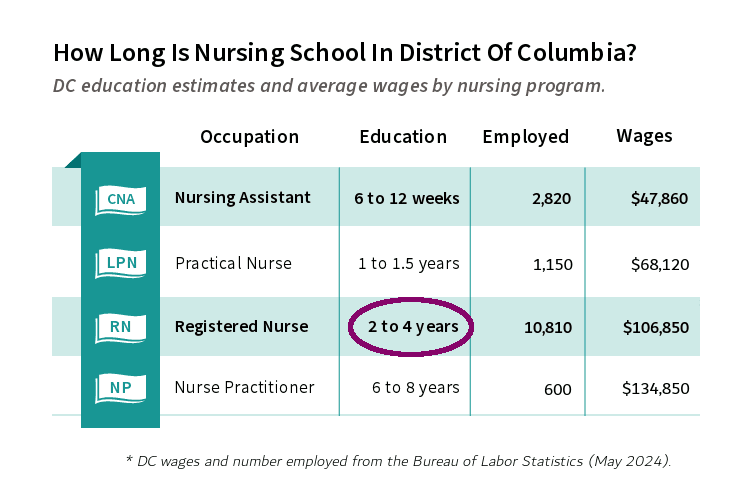
Researching and then applying to accredited nursing schools in District of Columbia can be a time-consuming task. For those just getting started in Nursing, we suggest that you focus on your near-term education goals and the District of Columbia licensing requirements. The first question to ask yourself is: Do I want to begin my career in the state of District of Columbia as a Nursing Assistant, Practical Nurse, or Registered Nurse? See our nursing education chart below for some insight into how long it takes to graduate from the most popular CNA, LPN, and RN nursing programs in District of Columbia.
District of Columbia Registered Nurse (RN) programs generally lead to an Associate Degree in Nursing (ASN), which typically lasts 2 years, or a Bachelor's Degree in Nursing (BSN), which lasts 4 years.
While earning an Associate Degree in Nursing (ASN) or Bachelor Degree in Nursing (BSN) is an important milestone for nurses, many District of Columbia nursing school students gain meaningful work experience and earn an income upon completion of a shorter Certified Nursing Assistant or Licensed Practical Nursing program in the state of District of Columbia.
Starting with a shorter CNA or LPN program can also strengthen your ASN or BSN application by showing commitment and clinical readiness. For those pursuing District of Columbia RN licensure directly, associate degree programs are often more accessible than bachelor's programs. Earning your RN through an ASN, then advancing through an RN to BSN program or RN to MSN bridge, is a common and effective path in District of Columbia.
Nursing Schools
List Of Nursing Schools In District of Columbia
Below is our list of accredited nursing schools in District of Columbia. In general, these colleges, universities, and training centers offer campus-based CNA, LPN, ASN, BSN, MSN, DNP, and PhD programs approved by the District of Columbia Board of Nursing. RN schools in DC will generally offer an ADN, ASN, or BSN nursing degree. Advanced Practice (APRN) and Nurse Practitioner (NP) programs can be found at larger schools that offer MSN and DNP degrees.
Click the name of any District of Columbia nursing school below to view the cost to attend, SAT and ACT scores, college or university characteristics, student body profile, satellite map of the surrounding area, and to view any additional nursing program information we have available in our database. Use the wishlist buttons provided to save institutions to a private list of nursing schools near you.
George Washington University
1918 F Street NW,
Washington,
DC
20052
202-994-1000
George Washington University is a Private not-for-profit institution with a campus in Washington, District of Columbia. The institution is approved to offer nursing programs by the District of Columbia Board of Nursing. The Washington, District of Columbia campus for George Washington University is located in a City setting. Total enrollment for all degrees including nursing programs is 25,568. In-state tuition and fees were $67,710 for the most recent reporting period. …
Nursing Programs: BSN, MSN, Post-MSN, DNP, PhD
- Tuition Cost $67,710
- Room and Board $16,920
- Acceptance Rate 44%
- ACT Score 31-34
Georgetown University
37th and O Street NW,
Washington,
DC
20057
202-687-0100
Georgetown University is a Private not-for-profit institution with a campus in Washington, District of Columbia. The institution is approved to offer nursing programs by the District of Columbia Board of Nursing. The Washington, District of Columbia campus for Georgetown University is located in a City setting. Total enrollment for all degrees including nursing programs is 20,392. In-state tuition and fees were $68,017 for the most recent reporting period. …
Nursing Programs: BSN, MSN, Post-MSN, DNP, PhD
- Tuition Cost $68,017
- Room and Board $20,596
- Acceptance Rate 13%
- ACT Score 32-34
Howard University
2400 Sixth Street NW,
Washington,
DC
20059
202-806-6100
Howard University is a Private not-for-profit institution with a campus in Washington, District of Columbia. The institution is approved to offer nursing programs by the District of Columbia Board of Nursing. The Washington, District of Columbia campus for Howard University is located in a City setting. Total enrollment for all degrees including nursing programs is 13,416. In-state tuition and fees were $35,810 for the most recent reporting period. …
Nursing Programs: BSN, LPN-to-BSN, RN-to-BSN, MSN, Post-MSN
- Tuition Cost $35,810
- Room and Board $17,322
- Acceptance Rate 35%
- ACT Score 22-28
The Catholic University of America
620 Michigan Ave NE,
Washington,
DC
20064
202-319-5000
The Catholic University of America is a Private not-for-profit institution with a campus in Washington, District of Columbia. The institution is approved to offer nursing programs by the District of Columbia Board of Nursing. The Washington, District of Columbia campus for The Catholic University of America is located in a City setting. Total enrollment for all degrees including nursing programs is 5,171. In-state tuition and fees were $58,378 for the most recent reporting period. …
Nursing Programs: BSN, MSN, Post-MSN, DNP, PhD
- Tuition Cost $58,378
- Room and Board $18,200
- Acceptance Rate 84%
Trinity Washington University
125 Michigan Ave NE,
Washington,
DC
20017
202-884-9050
Trinity Washington University is a Private not-for-profit institution with a campus in Washington, District of Columbia. The institution is approved to offer nursing programs by the District of Columbia Board of Nursing. The Washington, District of Columbia campus for Trinity Washington University is located in a City setting. Total enrollment for all degrees including nursing programs is 1,865. In-state tuition and fees were $26,610 for the most recent reporting period. …
Nursing Programs: CNA, PCT, BSN, RN-to-BSN, MSN, RN-to-MSN
- Tuition Cost $26,610
- Room and Board $12,180
- Acceptance Rate 99%
University of the District of Columbia
4200 Connecticut Ave NW,
Washington,
DC
20008
202-274-5000
University of the District of Columbia is a Public institution with a campus in Washington, District of Columbia. The institution is approved to offer nursing programs by the District of Columbia Board of Nursing. The Washington, District of Columbia campus for University of the District of Columbia is located in a City setting. Total enrollment for all degrees including nursing programs is 3,855. In-state tuition and fees were $5,662 for the most recent reporting period. …
Nursing Programs: CNA, LPN, ASN, RN-to-BSN
- Tuition Cost $5,662
- Acceptance Rate Open
How To Become
How do I become a nurse in District of Columbia?
If you want to become a Registered Nurse (RN) in the state of District of Columbia, you will need to complete a Registered Nurse training program. Registered Nurse programs generally last 2 to 4 years (see chart at the top of this page). Upon completion of your District of Columbia registered nursing program, you will have to pass the nationwide NCLEX-RN exam. After you pass the NCLEX-RN exam, you will apply for a Registered Nurse license from the District of Columbia Board of Nursing.
If you want to become a Licensed Practical Nurse (LPN) in the state of District of Columbia, you will need to complete a Practical Nurse training program. Practical Nursing programs generally last 1 to 1.5 years (see chart at the top of this page). Upon completion of your District of Columbia practical nursing program, you will have to pass the nationwide NCLEX-PN exam. After you pass the NCLEX-PN exam, you will apply for a Practical Nurse license from the District of Columbia Board of Nursing.
How Long It Takes
How long is nursing school in District of Columbia?
The amount of time you spend in a District of Columbia nursing school will vary based on the career path you choose. You can become a Certified Nursing Assistant (CNA) in as little as 6 to 12 weeks. Become a Licensed Practical Nurse (LPN) in 1 to 1.5 years, a District of Columbia Registered Nurse (RN) in 2 to 4 years, or stay in nursing school longer to become a Nurse Practitioner in 6 to 8 years.
Above on this page, we created a chart that summarizes how long nursing school is in District of Columbia. That chart includes the number of nurses employed in the state of District of Columbia, along with the average wages earned at each education level.
Notice that in the state of District of Columbia, far greater numbers are employed as Registered Nurses (RN) compared to Licensed Practical Nurses (LPN). Notice also that a Licensed Practical Nurse (LPN) in District of Columbia earns far more in wages compared to a Certified Nursing Assistant (CNA).
Use the nursing program acronyms CNA, LPN, ASN, BSN, MSN, DNP, and PhD to help identify which District of Columbia nursing schools offer the length of program you desire.
Tuition Cost
How much does nursing school in District of Columbia cost?
Tuition for a nursing school in District of Columbia will cost between $5,000 to $7,000 per year for state residents seeking a two-year Associate degree, an ADN, or ASN, for example. The larger public four-year colleges and universities in District of Columbia cost more, between $6,000 to $10,000 per year, for state residents seeking their Bachelor Degree in Nursing (BSN).
To help reduce the cost of nursing school in District of Columbia, a student can generally take their pre-nursing courses at a smaller two-year college. Then, transfer those credits into the larger four-year college or university of your choice. Each college has its own method of awarding transfer credits for pre-nursing coursework. You will need to plan ahead and question the receiving school before you start your first pre-nursing class.
Difficulty
Is it hard to get into a District of Columbia nursing school?
We list the quoted acceptance rate provided by each District of Columbia nursing school. A college acceptance rate is calculated by dividing the number of accepted students by the number of total applicants. Reviewing the list of nursing schools in District of Columbia provided above, we can see the acceptance rates range from about 13% to 100% or Open. SAT and ACT scores are displayed on each individual nursing school page.
If you are having trouble getting accepted into a District of Columbia nursing school due to a below average GPA, SAT, or ACT score, here are two strategies which might help: 1) take your pre-nursing courses at your local community college then reapply later as a transfer student with an above average GPA, and, 2) get your Nursing Assistant or Practical Nurse license to help you gain experience and stand out from other college applicants.
Compact State
Is District of Columbia a nursing compact state?
No, District of Columbia is currently not part of the nursing license compact agreement. States that join the Nursing Licensure Compact (NLC) allow the Licensed Practical Nurse (LPN) and Registered Nurse (RN) to practice in other participating states using one multi-state nursing license. This means that a District of Columbia Licensed Practical Nurse or a District of Columbia Registered Nurse must apply for a license by endorsement when moving to another state.
Last updated: February 5, 2026
References:
- District of Columbia Nursing License Requirements. State of District of Columbia, Board of Nursing. Retrieved February 5, 2026.
- District of Columbia State Occupational Employment and Wage Estimates. U.S. Bureau Of Labor Statistics, Occupational Employment Statistics. Retrieved February 5, 2026.
- Tuition And Characteristics Of District of Columbia Colleges. U.S. Department of Education, National Center for Education Statistics. Retrieved February 5, 2026.
- District of Columbia Nurse Licensure Compact Status. NCSBN, National Council of State Boards of Nursing. Retrieved February 5, 2026.